Like many countries, Japan uses a 12-month calendar. The names are very simple. January is 一月 (ichi-gatsu, literally “Month one”), February is 二月 (ni-gatsu, “Month two”), etc.
However, before the Meiji Restoration (mid-1800s) it was common to use an older 12-month system. These months’ names referenced the weather and the seasons (similar to the French Revolutionary calendar).
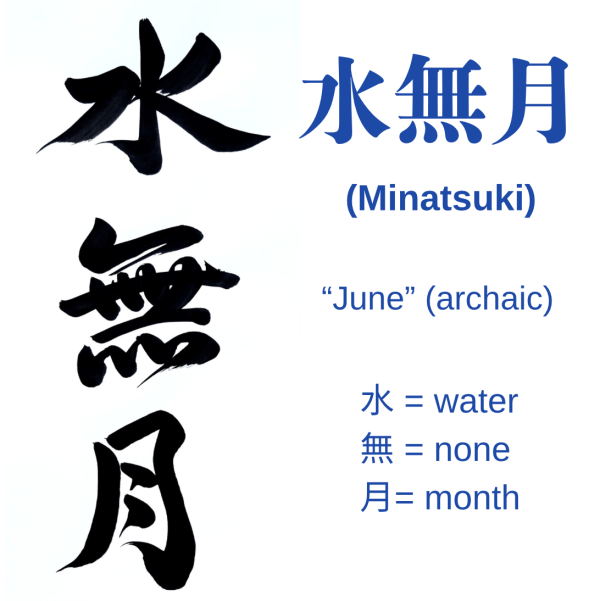
June is “Minatsuki” in this old Japanese calendar.
水 = water
無 = none / not any
月 = month
無 means “not any”, not “of”.
So why doesn’t this mean “the month with no water”?
According to wikipedia, this 無 is used purely as an ateji, which is a kanji used for its pronunciation rather than its meaning. 無 is pronounced “na”, which sometimes has the same meaning as the possessive particle の (“no”), thus rendering the meaning something like “water’s month”.
Which makes sense, given that June is usually the time of the Japanese rainy season!

