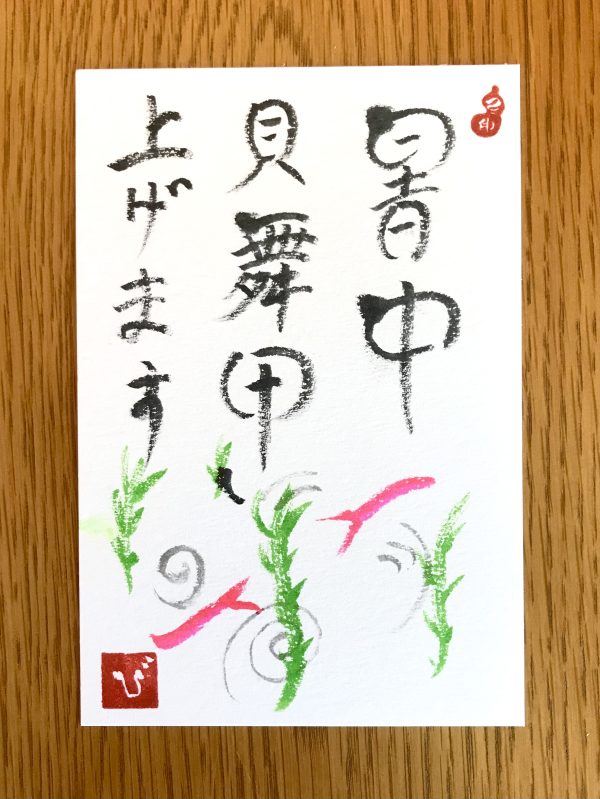
In Japan there is a tradition to send gifts and cards in mid-summer, to let your loved ones know that you are thinking of them during the oppressively hot summer days.
These cards are called 暑中見舞い (sho-chū-mi-mai) cards, which is usually translated as “summer greetings”.
Japanese learners will know that 見舞い (mi-mai) refers to visiting a sick person in hospital. So by sending a “summer greetings” card, the nuance is that you are also caring about the recipient’s health, hoping that they are holding up under the unbearable summer heat.
This work is in a new kind of calligraphy style called 己書 onoré-sho .
己 Onoré = I/me
As Japanese language learners will know, Japanese has A LOT of ways of referring to oneself, all with slightly different nuances.
“onoré” is old-fashioned, rough, and rather self-centred.
書 Sho = writing
So 己書 “onoré-sho” means something like “my own personal writing style (and I don’t care what anyone else thinks!)”
Onoré-sho doesn’t have many rules as such; you are encouraged to do things “your own way”. However, some guidelines are:
- Brush-strokes are usually written in the opposite direction to “proper” calligraphy
- All the lines should fit together like a jig-saw
- Thicker lines are usually written as large circles
- Curves are encouraged
- illustrations are encouraged too
 Calligraphy by Vicky