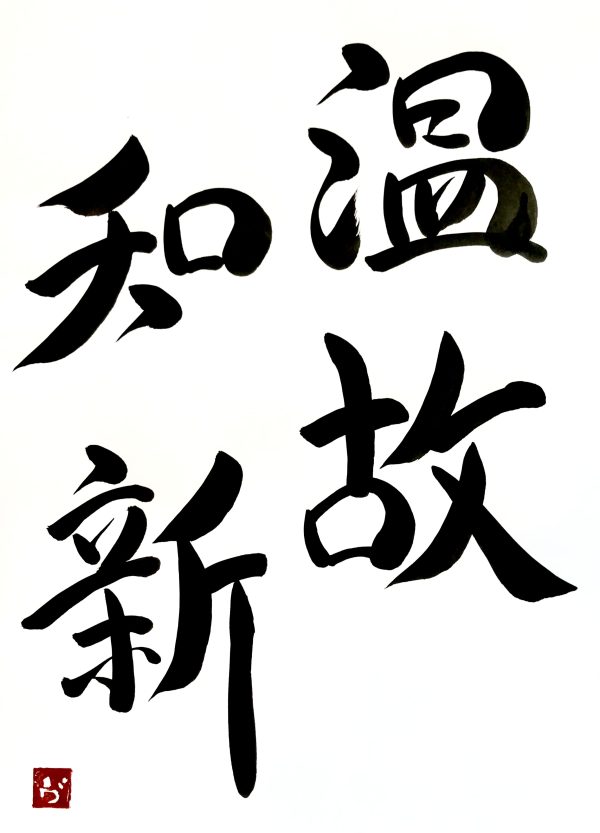
The kanji:
温 = warm
故 = circumstance
知 = knowledge
新 = new
This 4-character idiom means “learning from the past to gain new knowledge”.
“Knowledge” is represented by the third kanji 知, as in the Japanese verb 知る (shiru) “to know”.
“New” is represented by the fourth kanji 新, as in the Japanese adjective 新しい (atarashii) “new”.
So how about “learning” and “the past”?
It seems that the second kanji 故 is an ancient version of 古, as in 古い (furui) “old”.
As for “learning”… a bit of research reveals that 温 (meaning “warm”) used to be pronounced たずねる (tazuneru), which means “inquire”, and these days is written with a different kanji.
温故知新 is a special kind of Japaneses idiom known as a 四字熟語 (よじじゅくご、yo-ji-juku-go), or 4-character idiom. As the name suggests, these are idiomatic phrases made of 4 kanji characters.
They often contain a small life lesson or moral message, similar to English sayings such as “you reap what you sow” and “the early bird gets the worm”.
 Calligraphy by Vicky