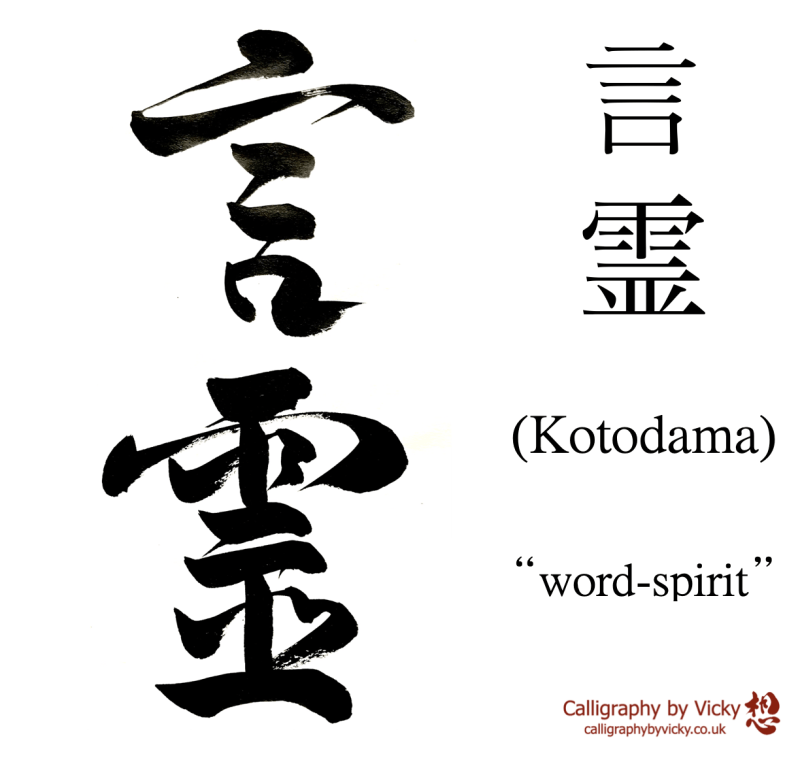
Koto-dama 言霊 is a traditional belief that mystical powers dwell in words and names.
Just like martial arts practitioners giving out a shout when they make a strike (“ki-ai!” – literally “meeting of spirit”) it is believed that sounds can affect our body, mind and soul.
 Calligraphy by Vicky
Vicky- i absolutely love everything you have created and especially this. So much so- I am contemplating it as a tattoo- it speaks to what I always believed that words spoken and not spoken are as powerful as actions. I just was hoping that you may clarify that your translation and understanding of how the kanji symbols are used and placed in fact represent your interpretation…would greatly appreciate it! Your work is amazing
LikeLike
Hi Chris, thanks for your kind comment!
There is a more thorough exploration of “kotodama” here:
https://japantoday.com/category/features/lifestyle/%27kotodama%27-the-belief-in-the-magic-power-of-words
From reading the above article, it seems that my interpretation of this word is accurate.
If you have any more questions, please feel free to ask.
And if you do get it as a tattoo, I’d love to see a photo 😉
Vicky
LikeLike
that was kind to send the article …I just finished bushido by Nitobe and happened upon your articles and calligraphy- which is beautiful! I then came across this match of Word Spirit and loved it.
does the change of symbol via calligraphy possibly change the meaning or is their freedom given in that realm of writing. I know the symbols change meaning with the slightest variation
LikeLike
Hi Chris
You’re right, many symbols (called “kanji”) are very similar, and the slightest variation can lead to a difference in meaning. For example: 大 means “big”, 太 means “fat” (notice the little extra line near the bottom), and 犬 means “dog”. I’m not quite sure what a dog has to do with “big”, or “fat”, but sometimes the logic behind kanji is lost in the mists of time 🙂
For the reasons above, you have to be careful about what you’re writing in terms of the brush strokes. Having said that, there is a fair amount of leeway in the style of the brushstrokes. The same kanji can be written in many different styles, each one giving a different “feel”.
If you want to take a look at kanji and kanji styles in depth, I recommend taking a look at these articles from the site of Matthew James – like me he’s a Brit who lived in Japan and studied calligraphy there. He’s a really decent bloke, and really knows his stuff.
https://yo-setsu.com/understand-calligraphy/
Vicky
LikeLike
You’re the best! Thanks for the article-very helpful. I’m so impressed that you not only learned the language, but perfected the artistic expression of calligraphy!!! Such a feat. You have been so kind- thanks 😊
LikeLike
You’re very welcome 🙂
LikeLike
love the other kanji you sent….prideful in a mature way and courageous alike.
Pain is certain, suffering is optional-Buddha
The root of suffering is attachment-Buddha
If you light a lamp for someone else, it will also brighten your path-Buddha
LikeLike