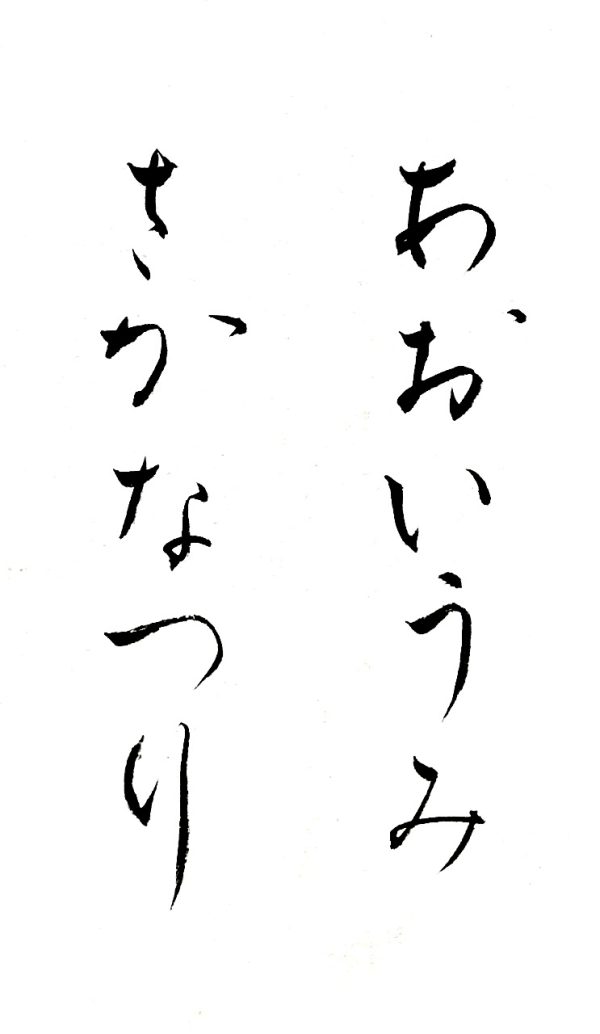
When Japanese writing is mentioned, the complex logographic kanji characters often come to mind.
However, kanji are not the only characters used to write Japanese.
The Japanese language uses multiple writing systems in combination. One of these writing systems is hiragana. Unlike kanji which have their origins in China, hiragana were first invented in Japan.
This article is a very basic introduction to hiragana. For info on learning hiragana, see the links to hiragana study resources at the end of this article.
What are hiragana?
Hiragana are a set of about 50 phonetic characters. Unlike kanji which represent meaning, hiragana represent sounds.
More specifically, they are a syllabary: they each represent a separate syllable of the same length (strictly a mora).
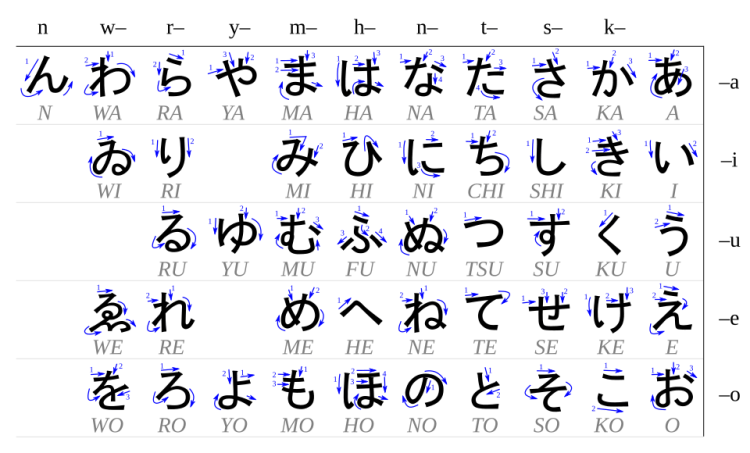
The above image shows the basic hiragana characters with their pronunciation in the Latin alphabet.
Using hiragana you can write any sound in Japanese.
Hiragana are recognised by their flowing curves, distinct from the sharp angles and straight lines of kanji and katakana.
How are hiragana used to write Japanese?
As mentioned before, multiple writing systems are used together to create written Japanese.
Hiragana are generally used for the functional, grammatical parts of the Japanese language:
- Prepositions (such as the English to, for, in)
- Conjunctions (such as the English and, but, or)
- Verb endings for conjugation (to show present tense, past tense, etc)
The following sentence illustrates each of these usages:
東京で友達と寿司を食べた。
The above sentence means:
(I) ate sushi with (my) friend in Tokyo.
The kanji is in red and hiragana is in blue.
東京 = Tokyo. This is written in kanji because it’s a name.
で = in/at. In hiragana because it’s a preposition.
So 東京で = in Tokyo.
友達 = friend. Nouns are generally in kanji.
と = with/and. This is a conjunction so hiragana is used.
So 友達と = with (my) friend
寿司 = sushi. It’s a noun so kanji is used.
を = a particle which attaches a noun (sushi) to a verb (ate).
食べた = ate.
So 寿司を食べた = ate sushi
As you can see from above, 食べた (“ate”) uses both kanji and hiragana.
食 is the kanji which represents the verb “to eat”. It can be conjugated by adding hiragana to express time, negation, etc:
食べる (taberu) = eat
食べた (tabeta) = ate
食べない (tabenai) = don’t eat
食べなかった (tabenakatta) = didn’t eat
So when the hiragana べた are added to the kanji verb stem 食, the verb becomes simple past tense “ate”.
If you can write all Japanese words in hiragana, why bother with kanji? Can’t you just use hiragana?
Yes. Yes, you can.
Young children often write everything in hiragana before they’ve learned all the kanji.
It might be tempting to just continue like this and not bother learning kanji, especially as there are thousands of kanji and they take years to learn.
However there are a couple of cases for putting in the effort to learn kanji.
1) Hair or paper?
The Japanese language has a lot of homophones (words which sound the same but have a different meaning).
Hiragana characters denote sound rather than meaning, which means that if you write everything in hiragana you can’t differentiate between words which have different meanings but have the same pronunciation.
For example:
髪 = hair
紙 = paper
These are clearly two different words with different meanings and different kanji.
However, they both have the same pronunciation: “kami”. (In standard Japanese the intonation, or “pitch” is also the same.) This means that they are both written the same in hiragana:
かみ
In conversation they are obviously differentiated by context, but in written language using different characters is often useful to ensure clarity.
2) Hiragana soup
The sentence used previously in this article uses both kanji and hiragana:
東京で友達と寿司を食べた。
Even without the different colours, the kanji stand out due to their complexity:
東京で友達と寿司を食べた。
Kanji tend to be used to write the words which are important semantically, such as nouns, verbs, names, etc. It can be said that kanji is used to highlight the key words.
The above sentence could of course be written completely in hiragana, in which case it would look like this:
とうきょうでともだちとすしをたべた。
As you can see, the lack of spaces between words makes it difficult to pick out the important words. It’s difficult to understand the meaning with just a quick glance.
Even beginner Japanese leaners and tourists are usually familiar with the kanji for Tokyo (東京) and other large Japanese cities such as Osaka (大阪). Knowing these kanji can be very useful when trying to find one’s way around a busy Japanese train station. Although Japanese train stations do usually write city names in hiragana as well as kanji, when Tokyo (とうきょう) and Osaka (おおさか) are written this way they are not nearly as easy to pick out at a glance.
Hiragana in calligraphy
In the world of Japanese calligraphy a combination of kanji and hiragana is common, such as in the example below.
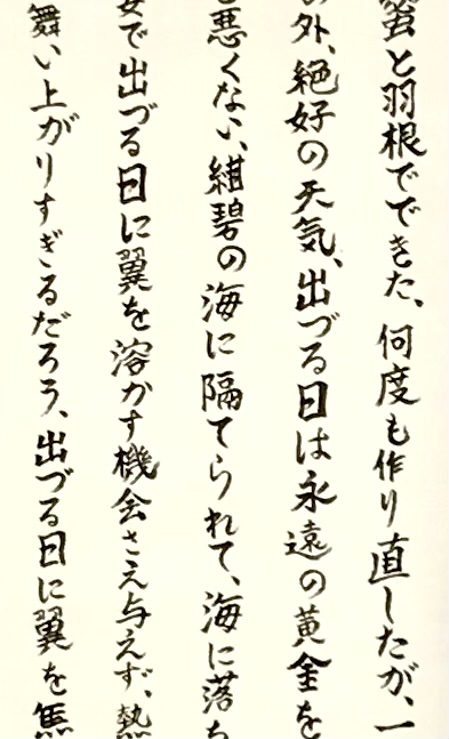
Purely hiragana works are also a thing, such as in my calligraphy in the image at the beginning of this article. This type of calligraphy is challenging because hiragana characters lack the straight vertical and horizontal structure of kanji, and yet they are not free-form: there are strict rules regarding the length and position of each brushstroke.
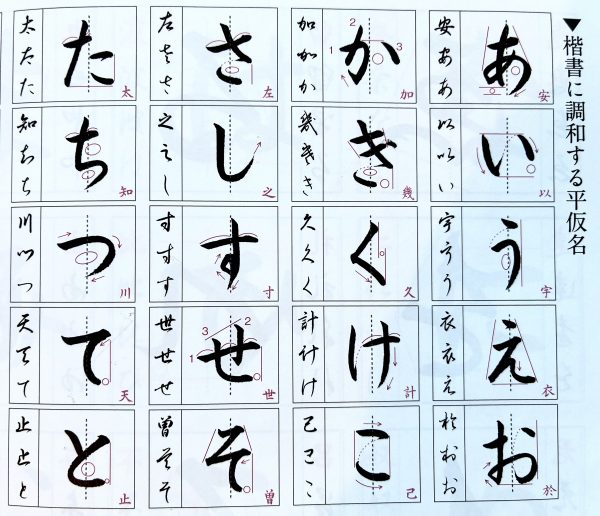
The image below is from a calligraphy guide. The pink lines and circles are a guide to creating a beautiful and correct composition for each character.
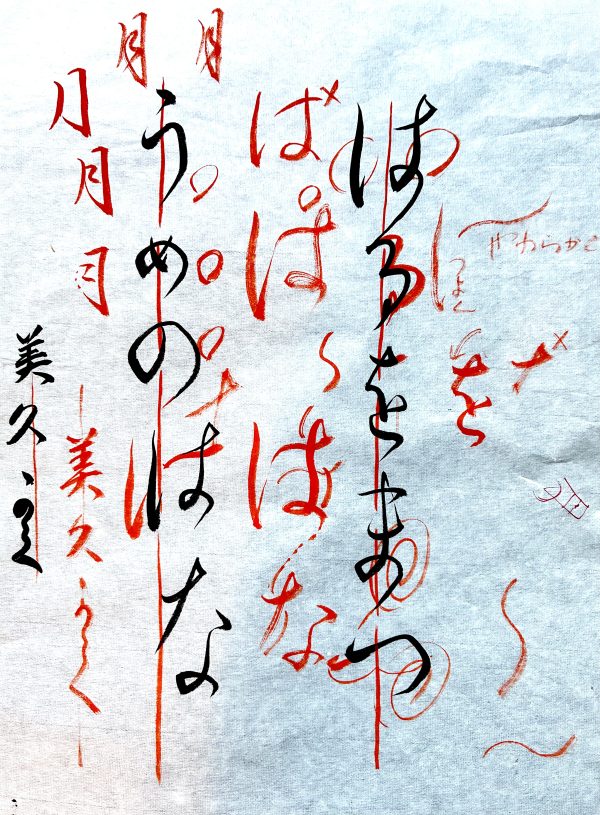
Below is one of my early attempts at hiragana calligraphy! The red ink is my teacher’s corrections.
Learning Hiragana
Reading and writing hiragana is easier than kanji, and is usually where Japanese learners start with written Japanese.
I learned hiragana by repeatedly copying the characters at the back of Japanese for Busy People. This method worked fine, but these days there are of course some great online resources which may save you time and effort. Some of my favourites are:
This comprehensive guide from Tofugu
This video from JapanesePod101
Renshuu, an app for learning Japanese which includes hiragana study
Kana Pro, a quiz-style platform for testing your hiragana and katakana recognition

