I spent a long time thinking about what to write for my first article about Japanese calligraphy.
There is so much to say, it’s difficult to know where to start.
Then I remembered that my teacher had once written a short introduction to Japanese calligraphy, which I had translated into English.
What better way to start than words from the master herself?
So here it is: An introduction to Japanese calligraphy, by my teacher:
About Shodō (Japanese calligraphy)
Japanese writing uses characters called kanji.
- Why were kanji first created?
Kanji were first created to communicate with the gods. Fortune tellers wrote kanji on animal bones, and threw them. Then the fortune tellers told leaders what to do, based on the way the animal bones landed. So this was a way of receiving instructions from the gods. This is how kanji first developed.
- Where and when did kanji come from?
It is believed that kanji were invented in China around three thousand years ago. At this time there was no paper, so characters were carved onto turtle shell and animal bones using a knife. This style of writing is called 甲骨文字 (kokotsumoji – fortune telling bone writing).
Two thousand years ago this fortune telling bone writing spread to each area of China. The first emperor of China ordered this writing to be used in every area, so that his kingdom would be easy to control. [My note – This is the same emperor who ordered the building of the Great Wall and the terracotta warriors.]
Over the years, kanji changed.
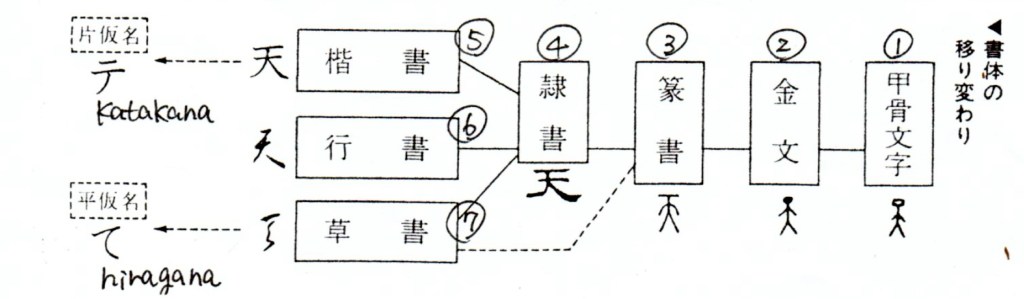
The diagram below shows the development of the kanji 天 (heaven):
- Fortune telling bone writing
- Metal writing
- Seal writing
- Clerical writing
- Standard writing – from these came katakana, another Japanese writing system
- Semi-cursive writing
- Cursive writing – from these came hiragana, another Japanese writing system
People who study shodō for a long time find that their personality is revealed in their writing style.
It is said that if you look at someone’s writing, you can understand their personality. Also, you can tell who has good handwriting just by observing that person.
On the other hand, it is also said that the activity of writing can change a person.
Therefore, if you study shodō, you can understand people’s psychology.
Everyone has a strong point, for example sports, music, study. In the future probably many people will go to foreign countries and express Japanese culture to the world.
Shodō is a good way of doing this.
With kanji characters you can express one idea with one character.
By changing the lines and the shape of the kanji, you can express your emotions.
In shodō, the lines are an expression of the heart. If you are wondering what kind of person you are, you will probably understand yourself better by writing.
A technique for good writing:
Pour your heart out into the letters and lines. Breath deeply inwards and then outwards. Feel like you are breathing life into the writing.
Vertical and horizontal lines express intellectual thoughts.
Diagonal lines express emotions.
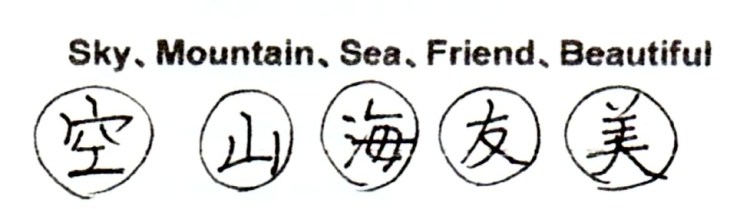
That’s all from my teacher! I hope her words gave a taster of what Japanese calligraphy is about.
In my next articles I’ll be exploring Japanese calligraphy and Japanese kanji characters in more depth.
 Calligraphy by Vicky