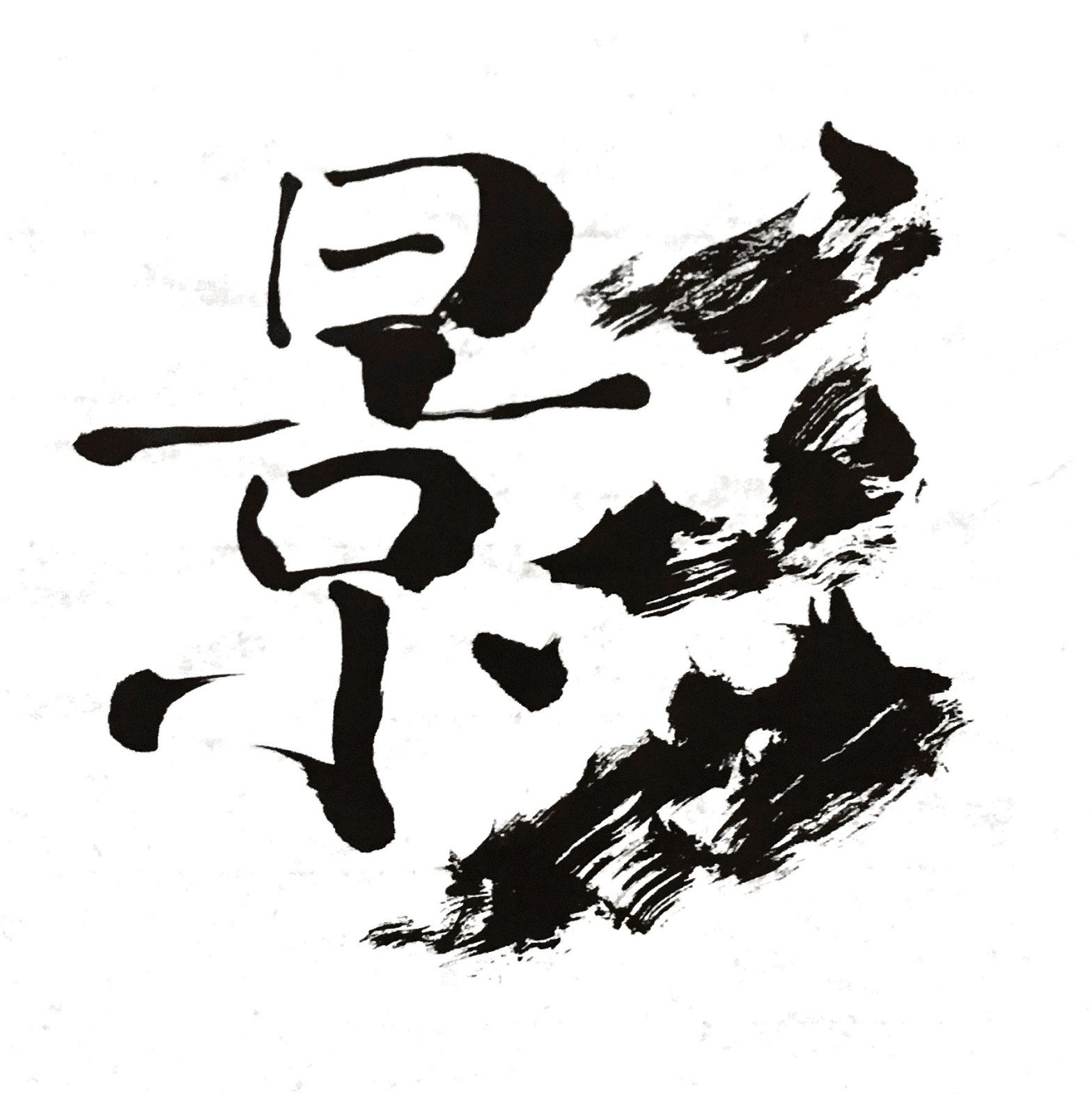
Japanese kanji characters are made up of smaller parts.
The left hand side of a kanji is called then “hen”. In the case of 影, the “hen” is 景, which means “scenery” and can be a complete kanji by itself.
The right hand side of a kanji is called the “tsukuri”. In this case the “tsukuri” is three diagonal lines, which refers to “hair” or “bristles”. As far as I am aware these three lines are rarely, if ever, used as a complete kanji by themselves (unlike 景 “scenery”), and nearly always appear in combination with other parts.
We can divide this 影 kanji into even smaller parts.
The “hen” 景 (scenery) can be divided further into the top part: 日 (“sun”) and the lower part: 京 (“capital city”).
These smaller component parts are called “radicals”.
Some radicals can only be used in combination with other radicals (such as the three line “tsukuri” mentioned above).
On the other hand, some radicals can function as complete kanji by themselves. 日 “sun” and 京 “capital city” both do this.
日 means “sun” or “day”, as in 日本 “Japan” – literally “the land of the rising sun”.
京 means “capital city” as in 東京 “Tokyo” – literally “East Capital” and 京都 “Kyoto” – literally “capital city” (Kyoto was the capital city from about 1100 to 1850).
 Calligraphy by Vicky