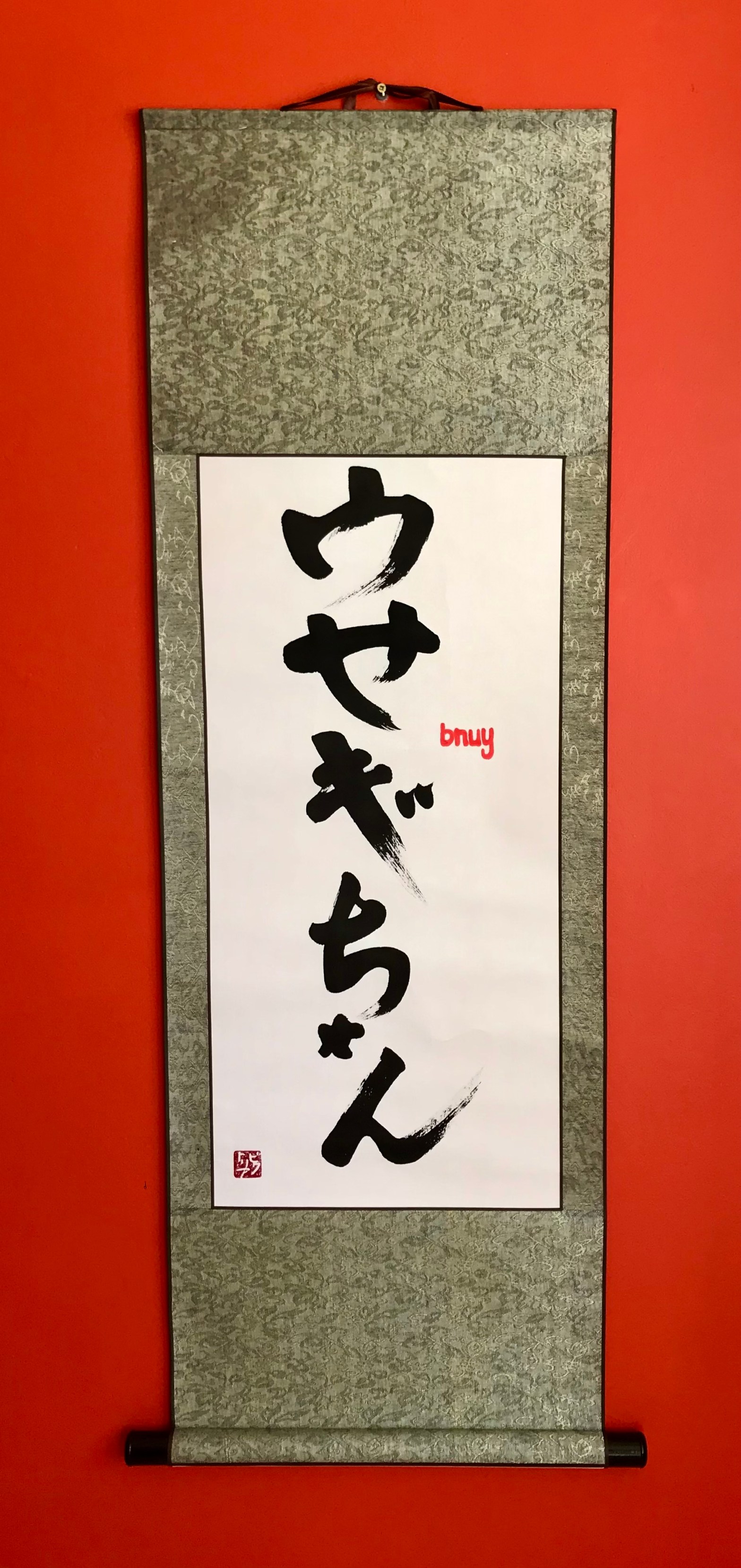
A friend commissioned me to create a Japanese calligraphy piece as a gift for someone who likes the word “bunny”, but always intentionally misspells it “bnuy” or “bnuny”.
The question is, how to interpret an English misspelling in Japanese?
My solution is as follows:
- “rabbit” = 「ウサギ」 (“usagi”)
2. Putting 「ちゃん」 (“chan”) after it makes it sound cute and childish. So 「ウサギちゃん」 is a good translation of “bunny”.
3. How about the misspelling? Changing the order of the katakana would result in something like “ugisa”. This would probably just sound like gibberish.
4. After consulting with my friend, I decided to horizontally flip one katakana – the サ.
What do you think? Does this interpretation work? 😉
 Calligraphy by Vicky