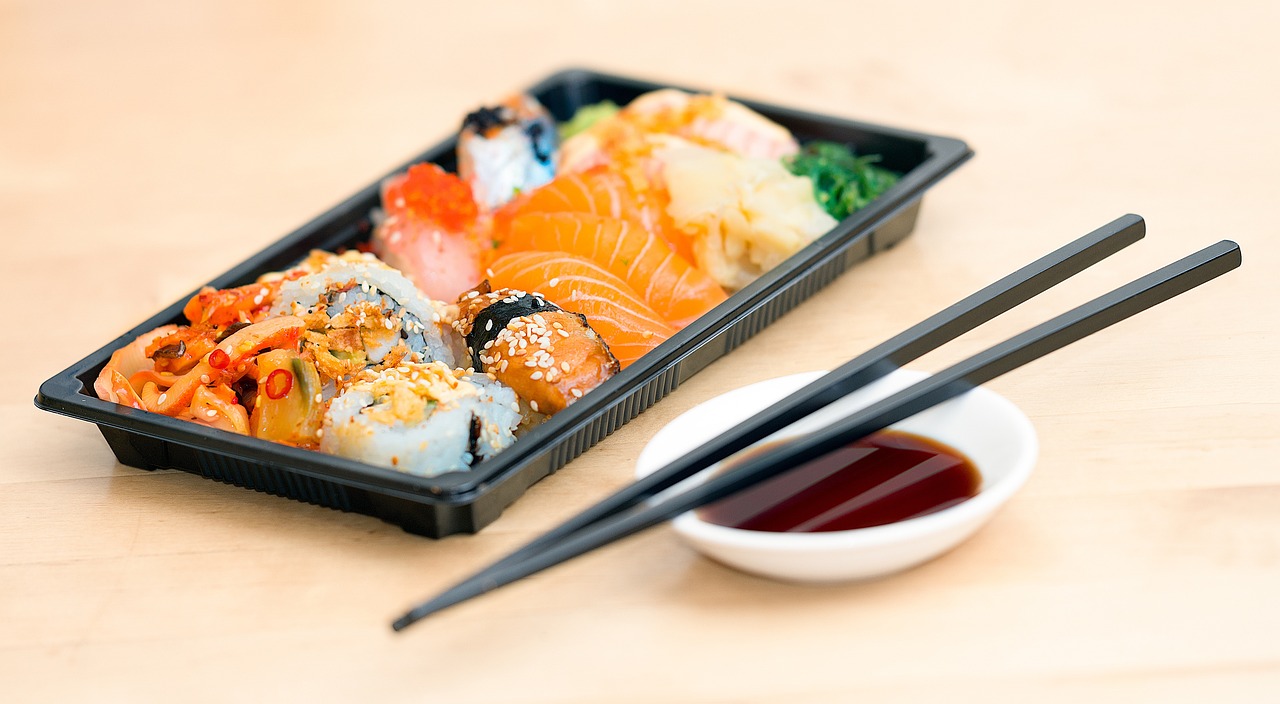
Image by Arek Socha from Pixabay
World-famous for its unique and varied cuisine, Japan is a foodie’s paradise. There are so many must-try dishes, from home-grown dishes such as sushi and udon, to those adopted from other countries such as ramen, curry-rice and tonkatsu (fried pork cutlet).
Unfortunately nowhere is perfect, and Japan can present some culinary difficulties to foreign travellers.
However, armed with some knowledge and a bit prior research and planning, you shouldn’t have too much difficulty finding something delicious to eat.
In this article I’m going to examine some potential difficulties, and then present some solutions.
- Your special dietary requirements may not be understood
This includes:
- vegetarianism/veganism
- food intolerances and allergies
- religious dietary requirements
In my home country of the UK it is pretty much the standard for restaurants to have a couple of vegetarian or vegan options on the menu. Gluten-free and lactose-free options are becoming very common too.
In Japan this is often not the case, with special dietary requirements not being well-known or well-catered to compared to many other countries.
2. Even if food is technically vegetarian / gluten-free / halal / etc., it might not be stated anywhere
Following on from the previous point, even if a restaurant does have (for example) vegetarian dishes on the menu, this might not be advertised anywhere or stated on the menu as these dishes are probably unintentionally vegetarian. This is generally also the case for other dietary requirements.
It is worth noting that this situation is changing, especially in large cities (see the “What to do” section below, part 1).
3. Asking for dishes to be altered is not standard procedure
In many eateries in Western countries, being able to accommodate customers’ special requests is considered a sign of good customer service. Many fast-food chains make a feature of the fact that customers can customise their meals exactly as they like.
In Japan this is the case in many ramen restaurants (for example, you can choose the thickness or texture of the noodles), and you can ask for various toppings.
It is also true that many Japanese fast-food restaurants provide a lot of menu options as regards combinations of toppings, amounts of various ingredients, etc.
However there isn’t really the opportunity to deviate from outside of those menu options; to ask for something to be removed, replaced, etc.
The attitude is that you get what you order. If you don’t want to eat something, just leave it on the side of your plate.
Obviously this isn’t an option if the thing you can’t eat is a sauce ingredient, which brings us to….
4. Dashi
Dashi is a type of stock and is a major component in traditional Japanese cooking. It is found in many dishes from the humble miso soup to the elegant kaiseki ryōri (traditional Japanese haute cuisine). It is an ingredient in many common sauces and soups, such as the soup used in many udon noodle and soba noodle dishes, and tsuyu (a common dipping sauce, often served with tempura).
It can be totally vegan if it is made from mushrooms (and is a large part of Shojin Ryōri — see part 6 of the “What to do” section below) but it is usually made from dried flakes of bonito fish.
Its sheer ubiquitousness makes it an obstacle for vegans, vegetarians or those who have fish allergies.
5. Mirin
A type of rice wine used for cooking, mirin is another very common ingredient. It is found in teriyaki sauce, as well as many other sauces and glazes such as tonkatsu sauce. It is similar to saké, but is sweeter and has a lower alcohol content (usually 14%). Although the alcohol evaporates during cooking, dishes containing mirin or cooking saké (ryōrishu) may be off the menu for those who are prohibited from alcohol.
WHAT TO DO
1. Head to the large cities / tourist areas / port cities
Many restaurants in large cities and popular tourist locations have realised that tourism is a lucrative market. Wanting to capitalise on this, they are starting to cater more to visitors with special dietary requirements.
Do an online search for “vegetarian restaurants Tokyo”, “Halal restaurants Osaka”, etc, and you should be able to find what you are looking for.
Port cities also tend to cater well to foreign visitors, most likely due to their immigrant populations. For example, Kobe has some halal restaurants and a small halal supermarket in the area north of Sannomiya Station. Find out where the foreigners hang out, and you’ll be likely to find some places which cater to your needs.
2. Try other nationalities’ cuisine
You came to Japan to try Japanese food, but if you can’t find anything you want there is always the option of foreign food. Despite being very proud of their own cuisine, Japanese people are generally very happy to try food from other countries. In large cities you can find many different nationalities’ restaurants. Indian restaurants are popular and can usually be relied upon to do vegetarian cuisine.
3. Choose your restaurant carefully
If you’re not located in a big city or tourist area your eating options may be more limited.
One tactic is to choose your restaurant carefully. Japanese restaurants (especially the smaller ones) tend to specialise in one particular type of food. So if you can’t eat gluten, stick to specialist donburi (a bowl of rice with toppings — usually meat) restaurants that serve rice dishes, and avoid noodle bars. If you don’t eat meat but will happily eat seafood, check out a specialist grilled eel restaurant or a sushi bar.
4. Go to izakayas
These are Japanese-style tapas bars. The big chain ones have extensive menus with tons of food and drink options (including soft drinks). With lots of little dishes to choose from, you’re bound to find something you can eat here.
5. Try a family restaurant
Haute cuisine they are not, but the cheap and cheerful “family restaurants” can be a godsend when you are looking for somewhere casual to relax. They often have multiple large menus (main menu, lunch-time menu, kids’ menu, seasonal menu…) and offer various types of food: American, traditional Japanese, Western-Japanese fusion, Italian, Chinese, etc. They cater well to large groups of people, and usually have an unlimited drink bar option. If they’re not too busy (and sometimes even when they are) they will often let you stay there for a few hours.
6. Eat like a Buddhist with shojin ryōri
Although many people in Japan are culturally Buddhist rather than devout followers of the religion, there are some Buddhist monks and nuns. They don’t eat any animal products (as well as some pungent foods such as onion and garlic). Their diet is called shojin ryōri. It is totally vegetarian, and often vegan.
This is not a diet which is familiar to most people in Japan, but there are some restaurants which specialise in this food.
More importantly for visitors, shojin ryōri is also a great option when considering accommodation. Some temples and monasteries offer lodging to visitors. This is known as shukubō, and is said to be an unforgettable experience. The food is, of course, shojin ryōri.
Bear in mind that shojin ryōri can contain mirin (rice wine for cooking). Buddha doesn’t eat animals, but he won’t say no to a drink.
7. Be careful when booking hotels and guest houses
Most large hotels in big cities and popular tourist areas cater well to foreign travellers. For smaller hotels and guest houses (including ryokan — traditional Japanese guest houses), food options may be limited. The owners will usually do their best to accommodate special dietary requirements, but sometimes this is only possible if it’s for more than a certain number of people. Check before you book.
8. Check out supermarkets and convenience stores for snacks
Vegetarians will find plenty of meat-free snacks to choose from. Check out this article for more about meat-free food shopping in Japan.
If you can’t drink cow’s milk, Japan has got you covered: the soy sauce company Kikkōman also produces soy milk. They have an insane number of flavours; you’ll be able to find at least one at any convenience store or supermarket.
If you find these tips useful, check out my other articles on the ways in which Japan can be inconvenient for foreign travellers:
 Calligraphy by Vicky