Part 2: Understanding Japanese apartment adverts
In my home country of the UK, renting is a pretty simple affair. It’s not uncommon to be able to sign the contract on the same day as the viewing.
Not so in Japan!
Renting an apartment in Japan can potentially be a long, complicated and drawn-out process; especially so if you don’t have Japanese citizenship.
In the first part of this three-part article I introduced a hassle-free alternative: renting a room in a share house for foreigners. This is often the best solution for those just starting out in Japan.
However, those of you have been in Japan for a while might want to try renting an apartment. If this is you, stick around because I’m going to tell you everything you need to know.
In the second part of this article I’m going to explain how to find a suitable apartment.
In Part 3 I’m going to explain how to go about the rental application process.
The apartment rental landscape
As mentioned in part 1 of this article, applying to rent an apartment in Japan can be a very lengthy procedure, often involving a complex three-way negotiation between the applicant, the letting agent and the landlord.
As far as Japanese letting agents are concerned, the landlords are the customers, not the tenants.
To keep the landlords happy, agents often demand much more paperwork and upfront costs than might be usual in your home country. I’ll talk about these later on in this article.
If you or your paperwork is rejected for any reason, be patient. Often the agency doesn’t make the rules — the landlords do.
You may have to find another letting agent, but in some cases the agent may be understanding and will either:
a) Recommend another apartment owned by a different landlord who does not make such strict demands.
b) Suggest a solution.
Needless to say, the whole procedure can take time, patience, and a decent level of Japanese language ability.
Even when you are accepted, your details will still need to be checked thoroughly to ensure that they (and you) are legit.
If you’re up for the challenge, read on!
Step 1: finding a letting agent
Letting agents are easy to spot because their windows are full of adverts for available apartments.
Well-known letting agents which are good for one- or two- person apartments are:
MiniMini in particular seems to specialise in small, cheap places, and for this reason is popular with university students.
All of these companies have websites, and these days many people choose to go apartment-hunting online.
Step 2: finding a suitable apartment
If you find an advert for an apartment that looks good, you can ask the letting agent staff about it. You can also tell the agency staff which area you want to live in, your requirements (how many rooms, etc), and they will look through their database to find somewhere suitable.
As well as specifying where you want to live, it is also very common to specify which train line you want to live near to. Japanese urban society is organised around train stations, so commuting time is very important. Often the most convenient place to live will not be determined by actual geographical location, but by proximity to a train station on a line which has stations near your workplace.
Step 3: understanding the advert
You’ve probably heard of the terms used to describe Japanese apartments: 1K, 2LDK, etc.
L = living room
D = dining room
K = kitchen
A “1LDK” is an apartment with a living room, a dining room, a kitchen, and 1 bedroom. Bear in mind that the living room, dining room and kitchen may actually be the same room. You’ll have to check the floor plan to see exactly what you’re getting (see below).
ワンルーム (wan-rūmu) = a one-room apartment
You’ve probably heard of the tiny apartments inhabited by some Tokyoites. These are “one-room” apartments. The one room functions as a bedroom, living room and kitchen. There is typically a bed, minimal furniture, a stove and a fridge in the same room. They usually have a “unit bath” (sometimes referred to as “UB”), which is a small room containing a bath, sink and toilet. (Unlike small apartments in other countries, Japanese apartments ALWAYS have a bath.)
I used to live in a “one-room” apartment, and I rather liked it. It didn’t feel cramped because it had a balcony (very common in Japan).
Let’s take a look at a typical advert. This is taken from the website of the popular letting agent MiniMini. (Red numbers added by me).
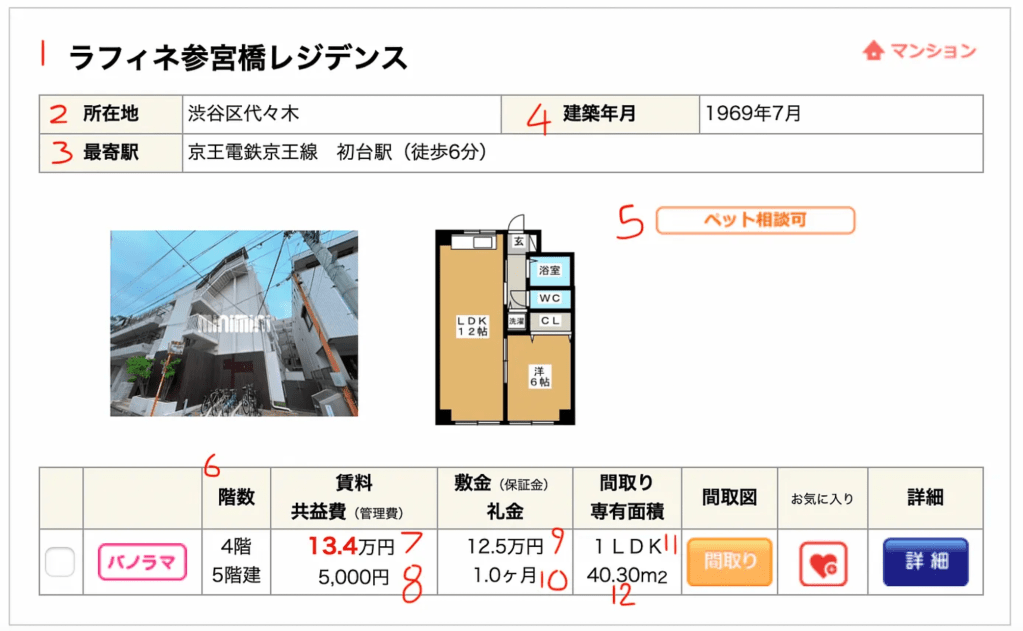
First, the floor plan
LDK = A combined kitchen/dining room/living room.
洋 = This is short for 洋室 (ようしつ, yōshitsu), a Western-style room. This means it doesn’t have a tatami mat floor. If it does have a tatami mat floor it will be labelled 和 (short for 和室, わしつ, wa-shitsu) — a Japanese style room.
帖 (じょう, jō) = This is the counter for tatami mats. So the size of this LDK room is 12 tatami mats, and the size of the bedroom is 6 tatami mats. The size of tatami mats varies depending on the region, but they are typically about 1m by 2m. This bedroom is Western style, so it won’t actually have tatami mats, but noting the dimensions in terms of tatami mats makes it easy to visualise the size. This house is quite old (by Japanese standards) so it may have once had tatami mat floors. Many old Japanese houses were built with the rooms created to fit tatami mats, not the other way around.
浴室 (よくしつ, yoku-shitsu) = Bathroom.
CL = Closet.
WC = The toilet. It’s common for this to be separate from the bathroom.
洗濯 (せんたく, sen-taku) = Washing (as in “washing machine”). This is a space which has plumbing for a washing machine. The washing machine may or may not be included.
玄 = Short for 玄関 (げんかん, gen-kan) = A small lowered area by the front door. You leave your shoes here before you step up into the main area.
This page from the GaijinPot website has more examples of Japanese floor plans and common terms.
Next, the other details (refer to my red numbers)
- The name of the apartment building
The name of this building is ラフィネ参宮橋レジデンス (Rafiné Sangūbashi Residence).
2. The geographical location
渋谷区代々木 (Shibuya-ku, Yoyogi).
区 (く、ku) = ward. Tokyo is divided into 23 wards. So this apartment is in Yoyogi (代々木 ), in Shibuya (渋谷) Ward (区).
3. The nearest train station and train line
京王電鉄京王線 = The Keio line 初台駅 = Hatsudai Station (徒歩6分) = 6 minutes’ walk
線 = line, 駅 = train station, 徒歩 = walking distance, 分 = minute
This apartment is a 6-minute walk from Hatsudai Station, on the Keio line.
If there are more nearby stations, these will be listed too.
Important! If this section lists a bus stop (停) but no train stations, this means it’s in the middle of nowhere and your morning commute will take forever.
Also important! The closer an apartment is to a train station, the more expensive the rent.
4. The year the apartment was built
1969年7月 = July 1969. For a country like Japan where residences are demolished and rebuilt in a (to my European mind) rather casual manner, this is pretty old.
5. ペット相談可 = Pet discussion ok
This means that the letting agent will allow you to discuss the possibility keeping a pet. Note that they might not allow you to actually keep a pet, just that a discussion about the topic is ok. To be honest, this is very up front on their part. Many adverts just say “Pet OK!”, which sounds like any pet is ok, but in reality usually only refers to tiny dogs, and anything larger than a Yorkshire terrier (including a cat) is not acceptable.
6. Floors
4階 = 4th floor, 5階建 = a 5-floor building.
It’s on the 4th floor of a 5-floor building.
7. Rent
13.4万円 = 134,000 yen (per month).
8. Apartment maintenance fee
5,000円 = 5,000 yen (per month).
9. Deposit
12.5万円 = 125,000 yen.
10. Key money (see below for more about this)
1.0ヶ月 = 1 month’s rent.
11. Layout
1LDK = A combined living/dining/kitchen, plus one bedroom.
12. Size
Even though the layout gives the size in number tatami mats, the size in square metres is also given.
Once you’ve found somewhere that looks good, you’re ready to start the application process. To find out more, check out Part 3!
 Calligraphy by Vicky
One thought on “The Unique Challenges of Renting in Japan — Part 2”