The Japanese language uses three writing systems: kanji, hiragana, and katakana.
Kanji are logograms – each character has a specific meaning. It is used to write “content” words such as nouns, verbs, adverbs and adjectives.
Hiragana and katakana are syllabaries – each character represents a single syllable sound rather than a meaning. Hiragana is used for showing verb inflections, for prepositions, and other “function” words. Katakana is used for imported words of non-Japanese origin.
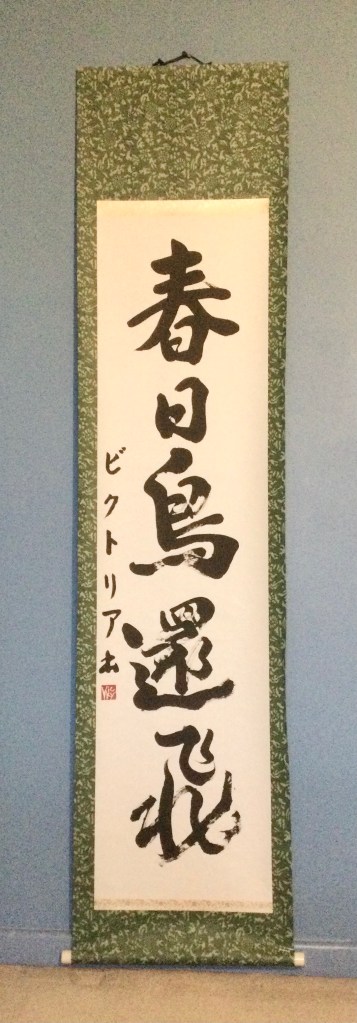
My work on the right contains 5 kanji characters:
春 (spring)
日 (sun)
鳥 (bird)
還 (return)
飛 (fly).
My name is not Japanese, so it is written in katakana : ビクトリア.
To learn more about the way Japanese writing systems are used, take a look at this article by StoryLearning:
 Calligraphy by Vicky